

JACK LEVINE: AMERICAN POLITICAL ARTIST
1915-2010
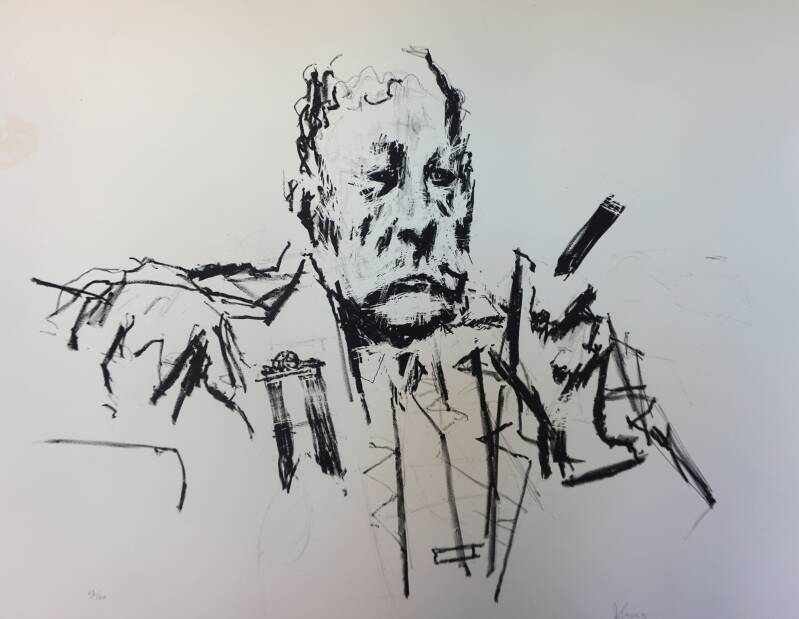
"The Texas Delegate" — lithograph printed in 1970
Jack Levine was an American painter who specialized in satirical and social commentary regarding class systems and authority structures in the west. Levine enrolled in art classes at the School of the Museum of Fine Arts, Boston and received free art lessons from Dr. Denman Ross of Harvard University, who recognized his exceptional talent. Levine grew up in the South End of Boston, where he saw street life composed of European immigrants and a prevalence of poverty and societal ills that influenced his work. His mother encouraged him to draw and stored his art materials in the family kitchen. On visits to his father's shoe store, he was given brown wrapping paper on which he would draw.
LISTEN TO VICTORIA CHICK DISCUSS JACK LEVINE'S ART & LEGACY ON BIG BLEND RADIO:
Levine ranks as one of America's most important twentieth century political artists. He developed an expressive and highly individualistic figurative style, and he used satire to deliver sharp social commentary and to lampoon the corruption and hypocrisy which he saw within America's political and military systems. Levine complemented his political art with more personal works. These pieces (produced during periods of profound grief) explored his Jewish heritage by revisiting (and reinterpreting) stories and parables from the Old Testament.
Levine joined the WPA's Federal Art Project, where he was employed intermittently until 1939. In 1937, while with the WPA, Levine painted "The Feast of Pure Reason," the work that catapulted him to fame. The painting, which depicted a politician, a policeman, and a "gentleman" of wealth, was interpreted by the press as an indictment of police corruption and its connection to wealth and organized crime.
In 1946, Levine married fellow painter Ruth Gikow and settled in New York City, where the couple raised their daughter, Susanna, who also became an artist. He remained in Manhattan for the rest of his life, and died there in November 2010 at age 95.
His lifelong devotion to drawing from life and, later, his personal interpretation with paint of human figures, particularly after his trip to Europe to study Old Master paintings, resulted in his strongly voiced dislike of abstract art when it became popular in the 1950s.
Levine once said of himself, "I am primarily concerned with the condition of man." Following his own direction, he created a distinct body of socially conscious art that probes the strengths and weaknesses of humanity.
Levine's work is featured in many public collections, including the Art Institute of Chicago, the Museum of Modern Art (MoMA), the Metropolitan Museum of Art, the National Museum of American Art, the Hirshhorn Museum and Sculpture Garden, the Brooklyn Museum, the Phillips Collection, the Whitney Museum of American Art, the Fogg Art Museum, the National Gallery of Art, and Southwest Regional Museum of Art.
Compiled by board member Victoria Chick. Source: Wikipedia